

Boost Your Small Business Reach with On-Page SEO: Your Ultimate Guide to Climbing Search Rankings
Small businesses can tap into local search demand by implementing smart on-page SEO tactics right on their websites. By fine-tuning title tags, content, and site structure, you can significantly improve search rankings and attract more qualified leads. This comprehensive guide from SMB Marketing Hub and Astound Media breaks down what on-page SEO is, why it’s a game-changer, and provides a clear, step-by-step plan. We’ll cover everything from keyword research and content optimization to technical SEO, local integration, measuring success, and practical tools to get you started. Understanding the best practices for small business SEO is key to unlocking this potential.
Here’s what you’ll discover in the following sections:
- What on-page SEO is and why it’s crucial for growing your small business
- How to nail keyword research specifically for local audiences
- Proven techniques to optimize your website’s content, headings, images, and links
- Essential technical on-page elements like URLs, meta tags, mobile-friendliness, and schema
- Strategies to seamlessly blend local SEO signals and your Google Business Profile with on-page efforts
- Key metrics, tools, and processes to track your on-page SEO wins
- Ready-to-use checklists, real-world examples, and helpful resources to speed up implementation
By the time you finish this guide, you’ll have a robust on-page SEO strategy that helps your small business stand out from the competition and attract more customers.
What Exactly Is On-Page SEO and Why Is It a Must-Have for Small Business Growth?
On-page SEO is all about optimizing individual web pages, such as content, HTML tags, and site structure, to rank higher in search results and be more relevant to users. This strategy sharpens your search visibility by aligning your page elements with the keywords your audience is searching for and their specific intent. The result? More organic traffic and better conversion rates. For small businesses, mastering on-page SEO is a powerful engine for sustainable growth, making it easier for you to be found, reducing your dependence on paid ads, and maximizing your local lead generation. Adhering to the best practices for small business SEO ensures these efforts are effective.
“On-page SEO is the foundation upon which all other digital marketing efforts are built. For small businesses, it’s the most cost-effective way to ensure they are discoverable by their target audience when it matters most – when a potential customer is actively searching for their products or services.” – Jorge Leger, Founder and Digital Marketing Consultant, Astound Media
On-page SEO elements – in plain English
On-page SEO means optimizing the bits and pieces within your website, like your text, headings, and HTML tags, to help search engines find you and rank you higher.
– Moz, What Are On-Page Ranking Factors For SEO? (2025)
How Does On-Page SEO Actually Make Your Small Business More Visible Online?
On-page SEO works its magic by sending clear signals of relevance and authority to search engines. When your title tags, headers, and meta descriptions perfectly match what users are searching for, search engines are more likely to feature your pages prominently. This boosted visibility translates directly into higher click-through rates, more organic traffic, and ultimately, more chances to turn visitors into loyal customers.
What Are the Core Components of On-Page SEO for Small Businesses?
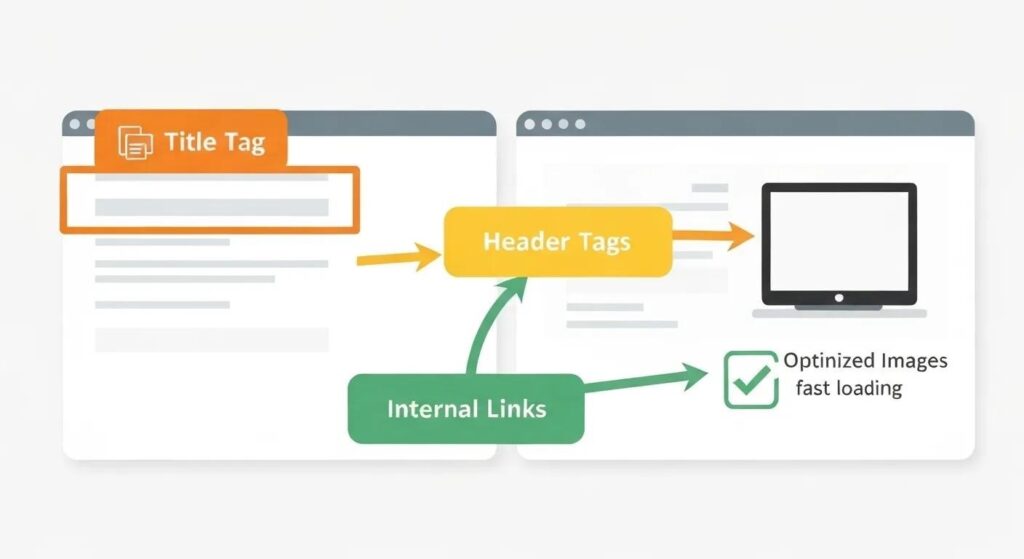
Before we dive deeper, let’s quickly review the foundational on-page elements every small business website needs to get right. These are fundamental to the best practices for small business SEO:
When you optimize each of these elements together, you create a powerful synergy that drives cumulative ranking improvements and positions your site to compete effectively for valuable keywords.
How Does On-Page SEO Directly Support Local SEO and Drive Leads?
On-page SEO is a crucial ally for local SEO because it allows you to strategically embed location-specific signals, like city names, service areas, and consistent contact information, directly into your page content and meta tags. Having clear NAP (Name, Address, Phone) details, dedicated landing pages for different locations, and using local business schema helps search engines connect your business with relevant local searches. By combining these on-page best practices with a well-tuned Google Business Profile, you can significantly amplify lead generation by capturing both map pack and organic search traffic.
Local SEO is a search engine optimization strategy – in plain English
Local SEO is all about boosting your rankings, traffic, and conversions by focusing on location-specific keywords and optimizing your Google My Business profile. The goal is to build a stronger local brand presence.
– Boostability, Local SEO for Small Business (2025)
How to Nail Keyword Research for Your Small Business On-Page SEO?
Effective keyword research is your compass, guiding you to the exact search terms your ideal customers are using. This insight is essential for creating content that resonates and optimizing your pages for maximum impact. By using the right tools and smart strategies, small businesses can uncover high-intent, low-competition keywords that drive local traffic and conversions. This is a cornerstone of the best practices for small business SEO.
What Tools Can Small Businesses Use to Find the Best Keywords?
Small businesses can sharpen their keyword strategy by leveraging reliable SEO tools that reveal crucial data like search volume, competition levels, and related search queries. Top contenders include Google Keyword Planner, Ahrefs, and Moz.
Keyword research tools – in plain English
Google Keyword Planner is a free tool within Google Ads that helps you discover keywords and plan your advertising campaigns.
– Zapier, The 4 best free keyword research tools in 2025
These platforms offer data-backed insights into broad, long-tail, and location-specific keywords that align perfectly with your offerings and audience intent. For even more analytics and expert recommendations, be sure to check out our Tools & Resources page.
How to Pinpoint Local and Long-Tail Keywords for Small Business SEO?
Discovering local and long-tail keywords involves mapping your services and products to specific geographic areas and understanding your customers’ unique pain points. Start by listing your core services (e.g., “emergency plumbing”) and pairing them with location modifiers (e.g., “emergency plumbing Chicago”). Then, expand with long-tail variations that capture user intent, such as “24/7 emergency plumbing repair near me.” Focus on keywords with moderate search volume and lower competition to maximize your chances of ranking.
How Does Keyword Research Shape Your On-Page SEO Strategy?
Keyword research is the bedrock of your on-page SEO strategy, dictating your content topics, title tags, headers, and meta descriptions to perfectly match search intent. The keywords you identify will guide your page structure decisions, placing primary terms in your H1 and URL, secondary terms in H2/H3 tags, and related phrases naturally within your body copy. By aligning your content with researched keywords, you ensure search engines clearly understand your page’s focus, rewarding you with higher rankings for relevance.
How to Optimize Content for Small Business Websites to Skyrocket SEO?
Creating high-quality, user-centric content is the absolute core of on-page SEO. Small businesses can build authority, boost engagement, and climb search rankings by following best practices for written content, multimedia, and internal linking. Implementing these content optimization techniques is vital for the best practices for small business SEO.
What Are the Best Practices for Writing SEO-Friendly Content?
SEO-friendly content strikes a perfect balance between providing genuine value to readers and incorporating keywords effectively. Begin by clearly defining your target topic and understanding user intent. Then, craft an engaging introduction, structure your content logically with subheadings, and write concise, easy-to-digest paragraphs. Embrace E-A-T principles, demonstrate Expertise with practical examples, Authority through data or testimonials, and Trust by ensuring accuracy and transparency. Aim for comprehensive coverage that fully answers visitor questions to encourage longer, more engaged site visits.
How to Use Header Tags (H1, H2, H3) to Structure Your Content Effectively?
Header tags act as a semantic roadmap, helping both search engines and users navigate your content with ease. Use a single H1 tag for your main topic, H2 tags for major sections, and H3 tags for sub-points within those sections. Proper header structure not only reinforces keyword relevance but also significantly improves content accessibility. For expert advice on building a solid website foundation, explore our Websites resources.
How to Optimize Images for Both SEO and Website Speed?
Optimizing your images is a dual win: it slashes load times, enhancing user experience, and provides search engines with valuable context. Use descriptive filenames (e.g., ) and alt text that incorporates target keywords and relevant entities. Compress your images to strike the ideal balance between visual quality and performance. Fast-loading visuals are crucial for Core Web Vitals, directly impacting your on-page SEO performance.
Why Is Internal Linking So Important for Small Business SEO?
Internal linking plays a vital role in distributing your website’s authority, guiding search engine crawlers, and improving user navigation. Using contextual anchor text, like “optimizing content for on-page SEO,” helps search engines understand the relationships between your different pages. By strategically linking from high-authority pages to newer or underperforming ones, you significantly boost their discoverability. Dive into our Content Marketing hub for strategies that seamlessly integrate on-page optimization with your broader marketing efforts.
What Are the Key Technical On-Page SEO Elements for Small Business Websites?
Technical on-page SEO ensures that search engines can efficiently crawl, index, and render your website. By simplifying these technical aspects, small businesses can maintain a healthy, high-performing website that ranks well. Mastering these technical elements is part of the best practices for small business SEO.
How to Create URL Structures That Search Engines Love?
SEO-friendly URLs are short, descriptive, and packed with relevant keywords. Include your primary terms (e.g., ) and steer clear of unnecessary parameters or lengthy strings of characters. Maintaining consistent URL patterns reinforces your site hierarchy and aids user recall, making your content easier to share and index. For design best practices, consult our Websites section.
How to Write Meta Titles and Descriptions That Grab Attention?
Your meta titles and descriptions are your prime real estate for capturing clicks directly from search results. Aim for titles under 60 characters that feature your primary keyword at the beginning. For meta descriptions, keep them between 150–160 characters, summarizing the page’s value proposition and including a compelling call-to-action. Well-crafted snippets not only boost click-through rates but also build immediate trust. For more optimization tools, head over to Tools & Resources.
How to Ensure Your Website is Mobile-Friendly and Loads Super Fast?
With Google’s mobile-first indexing, having a responsive design and excellent Core Web Vitals is non-negotiable. Utilize mobile-friendly templates, compress your images aggressively, and leverage browser caching to improve key metrics like LCP, FID, and CLS. Fast, accessible pages create a superior user experience and directly contribute to better rankings. You can find detailed mobile guidelines in our Websites hub.
How to Implement Schema Markup for Enhanced Small Business SEO?
Schema markup is structured data that helps search engines display richer results, making your listings stand out. Small businesses will find the most value in `LocalBusiness` and `Organization` schema types, as well as `HowTo` or `FAQPage` for step-by-step guides. Implementing a local schema can significantly boost your visibility in local map packs. For implementation examples and specific local strategies, explore our Local SEO page.
How to Seamlessly Integrate Local SEO With On-Page SEO to Maximize Small Business Visibility?
By weaving local SEO signals into your on-page strategy, you ensure your website and Google Business Profile work in perfect harmony to capture local search intent, driving more foot traffic and valuable inquiries. This integration is a critical component of the best practices for small business SEO.
How Does Optimizing Your Google Business Profile Supercharge Local Search?
A well-optimized Google Business Profile (GBP) complements your on-page efforts by providing essential location, hours, photos, and description details that align perfectly with your website content. Consistent NAP information and positive customer reviews on your GBP act as powerful trust signals for both users and search algorithms. When your website copy and GBP entries are in sync, you’ll see improved local pack rankings and more direct traffic to your site.
Local SEO strategies – in plain English
Optimizing your Google Business Profile is one of the most powerful local SEO strategies you can employ.
– Symboliq Media, Local SEO Strategies for Small Businesses
What Is Local Schema Markup and How Can You Use It Effectively?
Local schema markup is a way to embed your business information, like your address, phone number, and service area, directly into your website’s HTML using structured data tags. This markup anchors your website firmly in local search results and helps your listing appear in map packs. Pair local schema with consistent NAP information across your website for the most impactful results.
How to Leverage On-Page Signals to Elevate Your Local Search Rankings?
On-page signals such as location-specific landing pages, geo-tagged images, and embedded Google Maps powerfully reinforce your local relevance. Create dedicated service pages for each area you serve, strategically incorporate city and neighborhood keywords into your headings and body copy, and ensure your contact information is consistent across the web. These optimizations significantly strengthen your local SEO presence and attract more prospects who are actively searching for your services in your area.
How to Measure and Track On-Page SEO Success for Your Small Business?
Effectively measuring on-page SEO performance means diligently tracking organic metrics, identifying areas for improvement, and making data-driven adjustments. Consistent monitoring empowers small businesses to demonstrate ROI and continuously refine their strategies. Applying the best practices for small business SEO includes diligent tracking.
What Key Metrics Should Small Businesses Keep a Close Eye On?
- Organic Traffic to your most important pages
- Search Engine Rankings for your core and long-tail keywords
- Click-Through Rate (CTR) from search engine results pages (SERPs)
- Bounce Rate and Time on Page as indicators of user engagement
- Core Web Vitals for crucial page experience metrics
Tracking these metrics will clearly show which on-page changes are delivering the biggest impact and which areas might need further attention and optimization.
How to Use Google Analytics and Search Console for Smart SEO Monitoring?
Google Analytics and Search Console offer complementary, powerful insights. Use Analytics to understand user behavior, tracking sessions, engagement, and conversion paths. Leverage Search Console to monitor your site’s index coverage, see the organic queries driving traffic, and analyze rich result performance. Regular audits of both platforms are essential for spotting crawl errors, broken links, and untapped optimization opportunities.
Google Analytics and Search Console – in plain English
Connecting Google Analytics with Google Search Console gives you a unified view of your website’s SEO performance, bridging the gap between how visible you are in search and how users actually interact with your site.
– Victorious SEO Agency, Google Analytics vs Google Search Console: Which To Use (2025)
How to Spot and Fix Common On-Page SEO Mistakes?
Common on-page errors include missing meta tags, duplicate content issues, broken internal links, and unoptimized images. Regular site audits using tools like Screaming Frog, Ahrefs Site Audit, or our recommended Tools & Resources toolkit are invaluable for detecting these problems. Addressing each issue promptly is key to maintaining your ranking momentum.
Practical On-Page SEO Checklists and Case Studies for Small Businesses
Actionable checklists and real-world examples make on-page SEO implementation feel less daunting for busy small business owners, ensuring every step is clear and achievable. These resources are designed to help you implement the best practices for small business SEO.
What Is a Step-by-Step On-Page SEO Checklist for Small Business Websites?
Here’s a concise checklist covering the essential on-page tasks:
- Confirm mobile-friendliness and check Core Web Vitals scores
- Craft clear, keyword-rich title tags and meta descriptions
- Structure content with an H1 for the main topic and H2/H3 for subtopics
- Optimize body content with primary and related keywords naturally
- Add descriptive alt text to images and compress them for speed
- Ensure URL structures are short, descriptive, and keyword-inclusive
- Implement local schema and maintain consistent NAP on contact pages
- Build contextual internal links to your cornerstone and cluster content
- Monitor performance closely using Google Analytics and Search Console
- Refresh and republish high-traffic pages at least quarterly
This checklist will guide you through each optimization phase, laying a strong foundation for improved visibility and engagement.
How Have Small Businesses Seen Real Gains Using On-Page SEO?
From local service providers to e-commerce shops, businesses have experienced significant growth by implementing structured on-page SEO tactics. For instance, a neighborhood bakery saw a 35% increase in foot-traffic inquiries after optimizing its service pages and metadata. Similarly, an online retailer boosted organic product page sales by 28% through enhanced header tags, image alt text, and strategic internal linking. These success stories clearly demonstrate the tangible impact of focused on-page efforts.
What Tools and Resources Are Best for Small Business On-Page SEO Implementation?
Leveraging the right tools can dramatically speed up your optimization process and improve your analysis. Essential platforms include:
- Google Keyword Planner for in-depth keyword research
- Google Search Console for monitoring index status and performance
- Ahrefs or Moz for valuable backlinks and keyword insights
- Screaming Frog for comprehensive site audits
- The Tools & Resources section from SMB Marketing Hub for curated recommendations
These resources empower you to execute and validate on-page SEO best practices with confidence and efficiency.
Beyond SEO, don’t forget how complementary marketing channels, like targeted Advertising campaigns, engaging Email Marketing sequences, active Social Media presence, and optimized Ecommerce strategies, can amplify your organic efforts by driving repeat traffic and boosting your brand’s overall authority.
By consistently applying these on-page SEO best practices, your small business will be well-positioned to capture more search visibility, connect effectively with local customers, and achieve sustainable growth without straining your budget. For expert guidance or advanced technical support, consider partnering with Astound Media for professional SEO services.
About the Author
Jorge Leger is the Founder of Astound Media, a New York–based digital agency specializing in strategic web design and marketing. As a Digital Strategist and Marketing Consultant with over a decade of experience, he excels in WordPress, SEO, and automation. Jorge partners with mission-driven organizations, particularly small businesses and nonprofits, to create results-driven websites and campaigns that enhance their online presence.
