

Social media advertising is one of the most accessible and measurable channels available to small businesses, yet most operators start spending before they understand the system behind it. This guide explains how social media ads work, from auction mechanics and audience targeting to ad formats and conversion tracking, so you can make informed decisions before committing budget.
The scale of the channel is hard to ignore. Global social ad spend is projected to reach $338.75 billion in 2026, and 48% of social media users have purchased after seeing an ad. Social media ads improve brand awareness among billions of active users across platforms like Facebook, Instagram, TikTok, LinkedIn, Pinterest, and YouTube. Understanding the mechanics matters because the difference between wasted spend and measurable results usually comes down to how well you understand the system you are operating within.
This article focuses on how social media advertising works as a system and workflow, not on generic social media tips or deep cost tables. SMB Marketing Hub is an independent educational resource, so the guide stays platform-agnostic and tool-neutral. Whether you are running ads on Meta, TikTok, or LinkedIn, the underlying logic is largely the same.
A few terms to ground the discussion: a social media ad is any paid promotional content shown to a defined audience on a social platform. Paid social refers to this entire category of activity, distinct from organic content you post without paying to distribute. Digital marketing encompasses all paid and unpaid online channels, of which social media advertising is one component. Digital advertising, more broadly, includes search ads and display networks alongside social platforms.
What Is Social Media Advertising? (And How It Differs from Organic Content)
Social media advertising is a paid marketing campaign on social media platforms like Facebook, Instagram, TikTok, LinkedIn, Pinterest, YouTube, and X, where advertisers pay to show social media ads to defined audiences under controlled conditions of timing, location, and frequency. It is a subset of media advertising that operates entirely within social media channels.
The distinction from organic content is structural. Organic posts rely on the platform’s algorithm and your existing followers to generate visibility. Only a fraction of your audience typically sees an organic post. Paid ads bypass those limitations entirely. Social media advertising can guarantee visibility to specific consumer profiles, overcoming organic reach limitations. You choose who sees the ad, when, and how often.
Consider a local plumbing company in Austin. If they post a seasonal offer as an organic post, maybe 5–10% of their followers see it. If they run the same offer as a paid Facebook ad targeting homeowners within 15 miles, the ad reaches people who have never followed their page but match the profile of potential customers. The same ad content, entirely different distribution.
Social media ads typically resemble regular posts but carry labels like “Sponsored,” “Promoted,” or “Ad.” They can include clickable CTAs directing users to websites, lead forms, or shops. Common use cases include launching a new product, promoting an event, distributing a lead magnet to collect emails, and running a limited-time discount to increase sales, several of which overlap with the tactics in our guide to targeted ads for small businesses. In each case, the advertiser controls reach, targeting, and budget in ways that organic content simply cannot.
Core Building Blocks: How Social Media Ads Work Behind the Scenes
Almost every major social media advertising platform follows the same four building blocks. You pick a goal, choose your audience, develop ad creatives and ad formats, set your budget and bidding, and then analyze performance. This system turns business objectives into ad impressions and actions, regardless of which platform you use.
Think of these as the pillars of any campaign: objectives define what you want (awareness, leads, purchases), targeting defines who sees it (demographics, behaviors, custom audiences), creative and format define what they see (image ads, video ads, carousel ads), and the auction and budget determine how much you pay and when your ad runs. The flow is consistent: objective → audience → ad creative → auction → reporting.
Here is a quick narrative to illustrate. A small ecommerce brand selling sunglasses decides to run a 14-day campaign for summer sales. They choose “Conversions” as their objective, target women aged 25–40 who have browsed sunglasses-related content, create a carousel ad showing five styles, set a $15/day budget with automatic bidding, and track social media ad conversions using a pixel on their checkout page. Every element connects. A change in any one pillar affects the others. Successful campaigns use a structured approach involving goal setting, audience targeting, and performance tracking.
Campaign Goals: Telling the Platform What You Want to Achieve
The first decision in any social media ad setup is choosing a campaign objective. Common campaign objectives include brand awareness, lead generation, and conversions. Campaign objectives guide ad delivery optimization on social platforms, meaning the algorithm uses your stated goal to decide which users to prioritize within your target audience.
If you select “Conversions,” the platform’s algorithm optimizes delivery toward users most likely to purchase or complete a form. If you choose “Traffic,” it favors users most likely to click a link. If you select “Video Views,” it prioritizes people who tend to watch video content. The objective is not a label; it directly shapes which auctions your ad enters and which users see it.
For small businesses, practical goal-setting looks like this. A local fitness studio might aim to drive 50 class bookings in 30 days using a conversion objective. An online course creator might want to collect 200 email leads at under $3 per lead using lead generation. A retail store might want to generate 1,000 local impressions before an in-store event using a reach or awareness objective.
Mismatched objectives create real problems. Choosing “Engagement” when you actually want sales will produce likes and comments but few social media ad conversions. The platform optimizes for exactly what you ask for. Awareness objectives suit campaigns designed to increase brand awareness and brand recognition among new audiences. Traffic objectives work when you need to drive website traffic. Conversion objectives are appropriate when you want measurable actions like purchases or bookings. Choose based on the business outcome you are trying to produce, not the metric that looks most impressive.
Audience Targeting: How Platforms Decide Who Sees Your Ads
Targeting is the engine that makes social media advertising work. Social media ads allow brands to target specific audience segments using the platform’s massive store of customer data, including demographics, interests, behaviors, and on-platform actions. Advanced targeting technology allows reaching specific consumer groups that traditional marketing channels cannot isolate with the same precision.
Audience targeting can be refined by demographics, interests, and behaviors. Demographic targeting includes age, gender, location, language, and sometimes job title. Interest-based targeting uses topics a user follows or engages with, such as fitness, home improvement, or parenting. Behavior-based targeting looks at purchase patterns, device types, or travel habits. Social media ads allow hyper-targeting based on specific parameters, meaning a home services company can target audiences based on homeownership status within a specific zip code.
Custom audiences can be created from existing customer lists. If you have an email list or CRM data, you can upload it (hashed for privacy), and the platform will match those records to user profiles. This is how you reach existing customers with renewal offers or upsells, and it is how you build the foundation for scaling.
Retargeting means showing ads to people who visited your site, watched your video, or added to cart but didn’t buy. Retargeting can increase conversion rates by two to three times compared to cold audiences. Social media advertising can increase conversions through retargeting strategies because you are reaching people who already showed intent.
Lookalike audiences resemble your best existing customers for targeting. Platforms analyze the profiles of your best customers and find new users with similar characteristics. This is powerful for scaling beyond small custom audiences. A local restaurant might upload its loyalty program emails, build a lookalike, and reach targeted audiences of nearby diners with similar dining preferences.
Ad Creatives: What People Actually See and React To
Ad creatives include visual and textual elements like images, video, headline copy, primary text, and a call-to-action. This is what appears in the feed, Stories, Reels, or other placements. Creative quality is typically the single biggest performance lever available to advertisers in 2025–2026. Strong ad creatives can cut cost per conversion even with the same targeting and budget.
Clear offers, social proof such as reviews, testimonials, and star ratings, and simple messaging consistently improve social media ad conversions for small businesses. User-generated content, customer photos and testimonials, and influencer marketing collaborations can serve as powerful ad creatives because they carry authenticity that polished brand content sometimes lacks.
The most effective creatives blend with the platform’s native content style. TikTok-style vertical videos, Instagram Reels aesthetics, and LinkedIn’s professional tone: each platform has a culture. Ads that look like organic posts tend to outperform those that look like traditional advertising. Spark ads on TikTok, for instance, let brands promote organic posts from creators, maintaining that native feel.
Practical guidelines for small businesses: show the product in use within the first three seconds of a video. Use close-up photography for image ads. Avoid tiny text that becomes unreadable on mobile. Lead with the offer or benefit, not the brand name. And create content variations, because testing different ad variations is important to optimize performance and reduce costs.
Key Ad Formats: From Image Ads to Carousels and Stories
Ad formats are the structural packaging for your creative. Most social media advertising platforms offer a core set: single image ads, video ads, carousel ads, stories ads, and sometimes shopping ads, lead ads, or collection ads.
Static image ads highlight specific products or offers. They are the cheapest to produce, fastest to deploy, and effective for direct promotions. Use image ads for simple single-offer campaigns and quick tests against new audiences or messaging angles. They work well when the value proposition is immediately clear from a single visual.
Video ads balance entertainment and education for products. Short-form vertical video (Reels, TikTok, Shorts) is where most brands are increasing spend. Video performs particularly well for awareness campaigns, product demonstrations, and storytelling. The first one to three seconds need a strong hook. Production does not need to be expensive; smartphone-shot content often outperforms studio work.
Carousel ads allow showcasing multiple products in one ad. They are effective for product catalogs, step-by-step explanations, before/after sequences, or presenting multiple service offerings. Studies show carousels can generate significantly more impressions and interactions compared to single-image formats when used strategically.
Stories ads engage users without interrupting their experience. These full-screen, vertical placements are mobile-first and immersive, ideal for awareness, quick promotions, and time-limited offers. TikTok offers TopView ads that appear on app launch, capturing attention at the moment a user opens the app. Pinterest ads are effective for ecommerce businesses seeking sales, particularly through product discovery formats.
How the Social Media Ad Auction Works
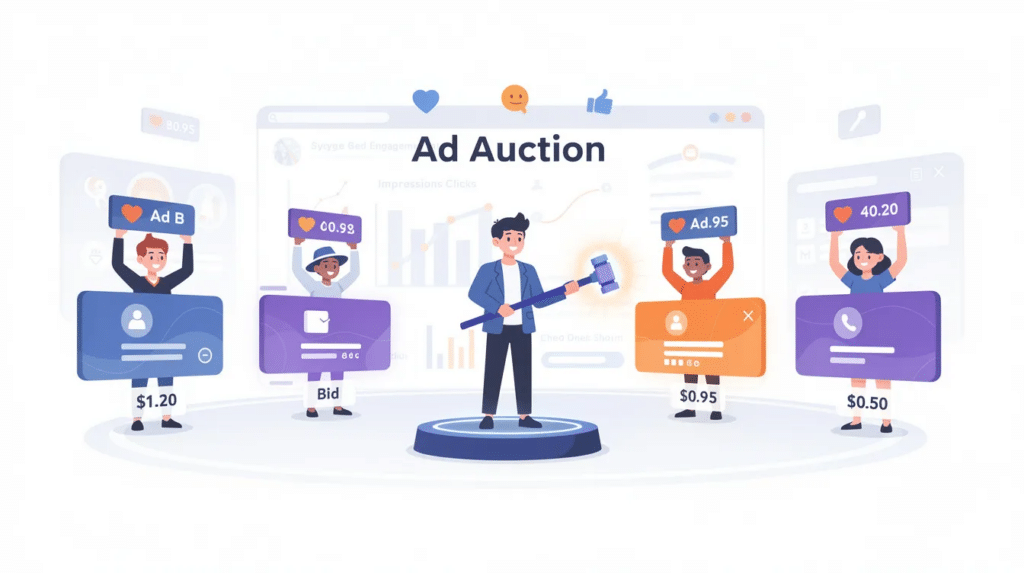
Social media advertising operates on an auction and delivery system managed by the platform’s algorithm. Every time a user loads their feed or opens a story, an impression opportunity arises. Advertisers enter an auction system to bid for showing their ads to that specific user at that specific moment.
The winning ad is not simply the one with the highest bid. Platforms determine the winner through a combination of three factors: the bid amount (how much the advertiser is willing to pay), the estimated action rate (the probability the user will take the desired action), and the ad quality or relevance score (based on user feedback, past performance, and creative relevance). Meta’s formula, for instance, multiplies these three inputs to determine “Total Value.” An ad with a lower bid but higher predicted engagement and better quality can win the auction.
This matters for small businesses. You do not need the biggest budget to compete. If your ad creatives resonate with your target audience and generate strong engagement signals, the platform rewards you with lower costs and more impressions. Two local gyms bidding in the same auction illustrate this: the gym running a generic stock-photo ad at a high bid may lose to the gym running a location-specific, testimonial-driven video at a lower bid, because the second ad generates better predicted engagement.
Most social platforms use second-price auction pricing, meaning the winner pays just enough to beat the next highest bidder, not their maximum bid. This prevents overpaying and keeps the system efficient. The platform’s algorithm optimizes delivery within your stated objective, entering your ads into auctions where the desired outcome is most likely.
Budgeting and Bidding: How Your Spend Gets Translated into Results
Social media advertising costs vary by platform and audience, but the budgeting system follows a consistent logic. You set either a daily budget (fixed spend per day) or a lifetime budget (total spend over the campaign period), and the platform paces delivery to use your budget efficiently while pursuing your objective.
Bidding strategies can include cost per click and cost per impression. Cost per thousand impressions, or CPM, means you pay each time your ad is shown 1,000 times, suited for awareness and reach. Cost per click, or CPC, means you pay when someone clicks, appropriate for traffic campaigns. Cost per conversion means you pay for completed actions like purchases or leads. Most platforms offer automatic bidding that optimizes for your chosen objective, though manual bid caps are available for more experienced advertisers.
Social media ads typically cost between $4 and $10 per thousand impressions in 2026. Average CPC for Facebook ads is around $0.40 to $0.70. Average CPM for Instagram ads is approximately $9.46. LinkedIn ads have the highest costs, averaging $5 to $12 per click, reflecting its B2B audience and higher lead values. Social media ad costs and social media advertising cost overall depend on competition, audience specificity, creative quality, and time of year.
For a fuller walkthrough of setting that number, see our guide to determining your monthly advertising budget. For small businesses, realistic starting guidance is $5 to $20 per day on a single platform or audience. This allows enough data to accumulate before scaling. Too-low budgets lead to slow learning and unstable results. Platforms will allocate more budget toward better-performing ad sets and creatives within your campaign, automatically favoring ads that drive cheaper results aligned with your objective. Treat early ad spend as a learning investment rather than a pure profit driver. The first two to four weeks are often about gathering data, not maximizing returns.
From Clicks to Customers: Tracking Social Media Ad Conversions
Social media ad conversions are the actions that matter: purchases, bookings, form fills, sign-ups, calls, or other tracked outcomes linked back to specific ad campaigns. Social media advertising provides measurable outcomes like lead generation, website traffic, and direct sales, but only if tracking is properly configured.
Platforms track conversions using pixels, SDKs, and server-side tracking tools such as Meta’s Conversions API or TikTok’s pixel. These tools record when someone who clicked or viewed your ad later completes a desired action on your website or app. Accurate tracking is crucial not just for reporting but for algorithm optimization: the platform uses conversion data to find more users likely to convert.
Measuring ad performance includes tracking CTR, CPC, and conversion rates, the same core numbers covered in our guide to essential advertising metrics. The funnel works like this: impressions lead to clicks, clicks produce a click-through rate (CTR), clicks lead to conversions, and conversions produce a cost per conversion and return on ad spend (ROAS).
A simple example: you spend $300, generate 600 clicks at $0.50 CPC, and 30 of those clicks result in a purchase, giving you a 5% conversion rate and a $10 cost per conversion. If your average order value is $45, your ROAS is 4.5×. These are the numbers that tell you whether a campaign is working.
Privacy changes since 2021, including iOS tracking prompts and cookie restrictions, have reduced tracking accuracy. Roughly 75% of iOS users opted out of cross-app tracking. This makes first-party customer data (your own email lists, website activity, and CRM records) more important than ever for accurate measurement and audience building.
How Social Media Ads Use Customer Data Responsibly
Social platforms aggregate customer data such as interests, pages followed, purchase behaviors, and engagement patterns to serve ads to the right users. Advertisers never see individual user identities. Instead, they define audience parameters, and the platform matches those parameters against its aggregated data to find eligible users.
There is an important distinction between platform-held data (likes, follows, watch time, user behavior patterns) and your first-party customer data (email lists, CRM records, website activity). You can upload your first-party data to build custom audiences and lookalike audiences, but the matching process uses hashed, anonymized connections. Platforms do not share individual records back to you.
Major privacy shifts since 2021 have reshaped how this system operates. Apple’s App Tracking Transparency prompted most iOS users to opt out of cross-app tracking, reducing platforms’ ability to observe off-platform behavior. Cookie restrictions in browsers have compounded this. Platforms responded with server-side tracking, aggregated event measurement, and modeled conversions using machine learning to fill gaps. The result is that consent-based first-party data and direct on-platform signals have become more valuable.
Small businesses should be transparent with their customers: maintain clear privacy policies, use proper opt-ins for email lists, and ensure compliant use of any customer data uploaded for advertising. Consult local regulations such as GDPR or CCPA when in doubt about data handling requirements.
Choosing Platforms and Ad Formats Based on Business Type
Rather than trying to be on every social media platform, small businesses benefit from focusing on one or two platforms that match their business model and target audience.
For ecommerce operators, Instagram and Facebook remain strong choices, with carousel ads and shopping ads enabling direct product discovery and purchase. Pinterest ads are effective for ecommerce businesses seeking sales, particularly for visually driven products. Ad spend on these platforms tends to produce measurable ROAS when paired with retargeting.
For local services, Meta platforms offer strong location-based targeting and conversion objectives suited to bookings, calls, and store visits; see our Facebook ad guidelines for local business for platform-specific setup details. Image ads and short video ads perform well for straightforward service promotions. The goal is typically to reach potential customers within a defined geography.
For B2B companies, LinkedIn provides targeting by job title, industry, company size, and seniority. While LinkedIn ads have the highest costs, the lead quality often justifies the premium for businesses selling high-value services or products. Lead generation forms built into the platform reduce friction.
For brands targeting younger audiences or building broad brand awareness and recognition, TikTok and Instagram Reels offer strong reach through vertical video formats. TikTok’s native ad styles, including spark ads and TopView placements, work best when the creative matches creator-style content rather than polished traditional marketing.
Start with simple experiments. Run image ads on one platform for 14 days, then test short video ads on a second platform with similar messaging. Compare campaign performance across formats and audiences to find what consistently engages with your specific customer base.
Improving Performance: Testing, Optimization, and Scaling
Optimization in social media advertising starts with a testing mindset. Rather than guessing which creative or audience will perform best, run controlled tests where only one variable differs between ad sets. Let data, not opinions, guide changes.
A/B testing at its simplest means comparing two versions of the same ad. You might test two different image ads against each other, or compare a video ad to a carousel ad, holding targeting and budget constant. When a bakery SMB A/B tested creatives on Meta platforms, their CTR rose 45% over two weeks simply by identifying which visual approach resonated.
Key optimization levers include adjusting targeting by narrowing or broadening audiences, refreshing creatives to avoid ad fatigue (performance drops when the same ad runs too long and users see it repeatedly), shifting budget toward top-performing ad sets, and improving landing pages or offers to boost conversion rates. Most brands find that creative refresh is the most frequent need: new visuals, angles, or offers every two to four weeks.
For scaling, once an ad set hits a stable cost per conversion, increase budget gradually by 20 to 30% every few days rather than doubling overnight. Sudden budget jumps force the algorithm back into its learning phase and can destabilize results. Scaling is a function of patience and data confidence, not ambition.
How Paid Social Complements Organic Content and Other Channels
Social media ads work best when they operate within a broader marketing strategy, not in isolation. A baseline of organic content, consistent posting, community engagement, and visible reviews creates social proof and trust that supports paid campaigns. When a user sees your ad and visits your profile, a history of organic posts signals credibility.
Organic content can directly inform your paid strategy. Identify your top-performing organic posts and repurpose them as social media ads. If a particular product photo or customer testimonial generated strong organic engagement, it is likely to perform well as a paid creative. Influencer marketing content and user-generated content can also be turned into high-performing ad creatives.
Paid social fits into wider marketing efforts as a complementary channel. You can feed email lists with lead ads, retarget website visitors who arrived through SEO or search ads, and support product launches already running in other social media channels. A local retailer, for example, might use organic Instagram to test messaging angles, scale the winners as paid ads, and use Meta retargeting to recapture visitors who came from Google. The goal is a cohesive marketing system where paid social, organic content, and other channels reinforce each other rather than competing for attention or budget.
This kind of integrated approach is what separates a marketing strategy from a collection of disconnected marketing efforts. Each channel plays a defined role in moving potential customers through the funnel.
Next Steps: Building a Simple, Repeatable Social Ad System
This guide covered the core mechanics of how social media advertising works: objectives that shape delivery, targeting that determines who sees your ads, ad creatives and ad formats that drive engagement, auction systems that determine cost, and tracking that connects spend to results. These are the same four building blocks that apply whether you are advertising on Meta, TikTok, LinkedIn, or Pinterest.
Here is a beginner-friendly starting plan. Pick one platform where your target audience is most active. Define one clear objective tied to a business outcome. Build one or two simple ad creatives, either image ads or a short video. Set a modest daily budget of $10 to $15. Run the campaign for at least 7 to 14 days to gather enough data for meaningful analysis. This is a cost-effective way to learn the system before committing larger budgets.
Document what you learn. Which audience responded? Which creative drove the lowest cost per conversion? Which format, image or video, produced better results? Build a lightweight internal playbook from these observations. Each campaign adds to your deep understanding of what works for your specific business, audience, and offer. The system is constantly evolving, but the fundamentals remain stable. Start with the basics, read the data, and build from there.
