

Personalized Email Campaigns for SMBs: Boost Your SMB Engagement Effectively
Personalized email marketing empowers small businesses to tailor messages, timing, and offers using customer data, ensuring content resonates with recipient behavior and needs. This guide reveals how personalized campaigns for SMBs increase engagement, conversions, and ROI through strategic segmentation, automation, and dynamic content. It provides practical workflows, templates, measurement tactics, and AI-friendly strategies like predictive personalization, addressing common challenges like limited data and tight budgets. You’ll gain concrete steps to implement powerful welcome series, abandoned-cart flows, and lifecycle emails, boosting engagement and customer lifetime value.
“For small businesses, personalized email marketing isn’t merely about sending tailored messages; it’s about building a direct, scalable bridge to customer loyalty and sustained growth. It transforms data into genuine connection.” – Jorge Leger, Founder and Digital Marketing Consultant at Astound Media
Personalized Email Campaigns: Why They’re Essential for SMBs
Personalized email campaigns for SMBs leverage customer data, like name, purchase history, or website behavior, to deliver highly relevant content and offers, boosting opens, clicks, and conversions. This leads to higher engagement and stronger customer relationships. For SMBs, personalization means fewer wasted sends and smarter allocation of limited marketing resources, improving ROI and customer retention. AI-driven predictive personalization allows businesses to infer likely purchases or churn risks from behavioral signals, enabling proactive responses.
AI in Email Marketing Automation: NLP and Predictive Analytics for Enhanced Campaigns
This paper explores the integration of Artificial Intelligence (AI) in email marketing automation, emphasizing the roles of Natural Language Processing (NLP) and predictive analytics algorithms in enhancing campaign effectiveness. As businesses strive to optimize customer engagement and conversion rates, leveraging AI technologies presents novel opportunities to personalize content and predict consumer behavior with unprecedented precision.
– Enhancing Email Marketing Automation with AI: Leveraging Natural Language Processing and Predictive Analytics Algorithms, 2021
What Exactly Are Personalized Email Campaigns for SMBs?
Personalized email campaigns for SMBs adapt messages to specific customers using data like name, purchase history, email engagement, and website behavior. Relevance captures attention, increasing open and click-through rates. SMBs can start with simple personalization tokens (e.g., first name), then add behavior-triggered messages (e.g., for browsed products) and purchase-based recommendations as data maturity grows. Personalization begins with collecting consented email addresses, tracking impactful behavioral events, and mapping these signals to automation triggers.
What Are the Core Benefits of Personalized Email Campaigns for SMBs for Boosting Engagement?
Personalized email campaigns for SMBs consistently improve engagement metrics by aligning content with customer intent, enhancing conversions, and loyalty.
- Higher Open Rates: Personalized and contextually relevant subject lines increase open rates compared to generic mass emails.
- Improved Click-Through Rates: Highly relevant content and dynamic offers boost your CTR by directly addressing customer intent.
- Better Conversion and Retention: Targeted sequences, such as post-purchase follow-ups and re-engagement campaigns, reduce churn and encourage repeat purchases.
These gains translate into stronger ROI, as fewer sends generate more valuable actions, allowing SMBs to reallocate budget.
Mastering Email Segmentation to Boost Engagement in Email Campaigns for SMBs
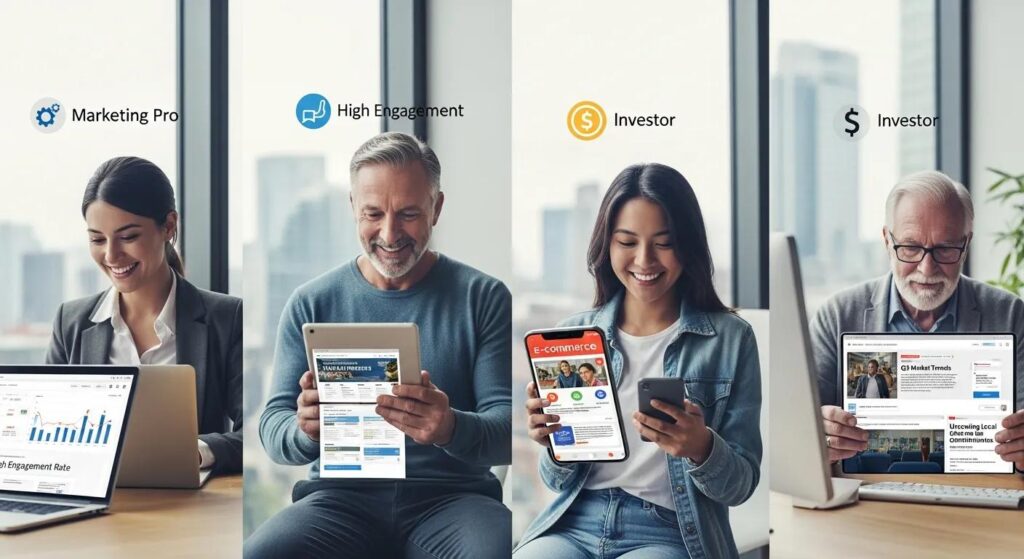
Segmentation divides your email list into meaningful groups, aligning messaging with each recipient’s unique needs. This involves collecting signals, creating smart segment rules, and mapping messages, yielding higher relevance and engagement. SMBs should prioritize segments easily built from basic data (e.g., purchase history, engagement, recency) that correspond to distinct offers or lifecycle stages.
- Behavioral Segmentation: Group customers by recent site visits, specific product page views, or email opens to target their current intent.
- RFM Segmentation: Utilize recency, frequency, and monetary value to identify valuable customers and those who might be lapsing.
- Lifecycle / Stage Segmentation: Separate new subscribers, active buyers, and dormant contacts to tailor sequences suited to their journey stage.
- Interest-Based Segmentation: Leverage clicks on category links or preferences indicated in preference centers to send topical and engaging content.
| Segmentation Type | Data Source | When to Use / Example |
|---|---|---|
| Behavioral | Site events, email clicks | Perfect for cart recovery and browse abandonment sequences |
| RFM (Recency/Frequency/Monetary) | Order history, transaction value | Ideal for prioritizing VIP offers and reactivation campaigns |
| Lifecycle Stage | Signup date, purchase timestamp | Use to trigger welcome series and essential nurture flows |
| Interest-Based | Preference center, link clicks | Great for category-specific promotions and engaging content newsletters |
What Are the Most Impactful Segmentation Strategies for SMB Email Lists?
Impactful segmentation balances ease of implementation with high impact for email campaigns for SMBs. Behavioral signals and straightforward RFM (Recency, Frequency, Monetary) tiers deliver strong returns. Implement RFM by exporting purchase data or using platform-built scoring to identify VIPs and churn risks. Combine behavioral segments with engagement triggers for timely cart reminders and re-engagement campaigns. Start small with three core segments (new, active, inactive customers), then expand to granular, interest-based groups as data accumulates.
How Does Smart Audience Segmentation Drive Targeted and Relevant Email Content?
Segmentation unlocks relevance by linking user characteristics to message intent: a specific segment receives a tailored offer, increasing conversions. For instance, ‘high-frequency purchasers’ get cross-sell recommendations, while ‘inactive subscribers’ receive reactivation offers. Tracking segment performance (open rates, CTR, conversion) validates assumptions and guides refinement. This continuous optimization ensures personalization remains precise and impactful.
Effective segmentation also supports privacy by minimizing unnecessary data and focusing on consented behaviors, boosting deliverability and building stronger trust with your audience.
Automate Personalized Email Workflows for Real Growth in Email Campaigns for SMBs

Automation empowers SMBs to deliver relevant messages at scale using smart triggers and dynamic templates. A trigger activates a template with personalization tokens, leading to an automated, timely, and impactful send. Automations reduce manual workload, maintain relevance across the customer journey, boost efficiency, and grow revenue without proportional time investment. Start with high-impact workflows, tracking each for lift.
- Welcome Series: Onboard new subscribers with 2–4 messages to set expectations and introduce offers.
- Abandoned Cart Sequence: Send timely reminders, often with social proof or small incentives, to recover lost conversions.
- Post-Purchase Nurture: Deliver follow-ups that confirm satisfaction, recommend complementary products, and invite reviews.
- Re-Engagement Flow: Craft win-back messages for dormant contacts, moving from valuable content to enticing discounts.
Automating these essential workflows frees up time for creative optimization, enabling more advanced triggers like churn prediction and cross-channel coordination.
Which Automated Email Campaigns Truly Drive SMB Engagement?
Automated campaigns deliver measurable lifts for SMBs by aligning with customer intent: welcome, purchase, and abandonment. A welcome series typically includes confirmation, value proposition, and a first-purchase incentive over 7–14 days. Abandoned cart sequences achieve high conversion rates with reminders within an hour, 24 hours, and a final incentive-driven message after 72 hours. Post-purchase sequences reinforce decisions, request feedback (7–14 days), and present cross-sell options. Measure each flow’s revenue per recipient and iterate on timing, copy, and incentives based on A/B test results.
How Can SMBs Seamlessly Integrate Email Automation with CRM Systems?
Integrating email automation with your CRM ensures synchronized customer profiles and events for personalization. Basic steps involve mapping fields, configuring sync cadence, and validating events to unlock lifecycle-driven automations. Native integrations often cover essential fields (email, first name, last purchase, order value) and are easy to set up. If native options are unavailable, middleware or API scripts can bridge the gap. Key steps include mapping core fields, defining clear event triggers (e.g., ‘order placed’), and setting a reasonable sync frequency to balance data freshness against API limits.
Maintaining data hygiene, through deduplication, consistent identifiers, and robust suppression lists, prevents errors and safeguards deliverability, making CRM integration a foundational step toward advanced personalization.
Best Practices for Crafting Personalized Email Content That Converts in Email Campaigns for SMBs
High-converting personalized content combines compelling subject lines, trustworthy sender identity, dynamic content blocks, and clear calls-to-action (CTAs) to match the recipient’s journey. Relevant content drives measurable responses. Dynamic content adapts email templates to showcase personalized product recommendations, region-specific offers, or reward-tier messages based on segment variables. For maximum impact, focus on concise copy, mobile-first design, and a single, primary CTA aligned with recipient intent.
- Sender Name Personalization: Utilize recognizable names or team aliases to boost trust and recognition.
- Contextual Subject Lines: Reference recent behavior or specific product names to increase open rates.
- Dynamic Content Blocks: Swap images or copy based on segment data for enhanced relevance.
- Clear, Single CTA: Direct the reader’s action with one clear next step.
How to Write High-Converting Personalized Subject Lines for Email Campaigns for SMBs?
Subject lines combining personalization tokens with contextual relevance outperform generic alternatives by signaling relevance and encouraging opens. Employ proven formulas like ‘[First Name], a quick tip for your recent purchase’ or ‘Items left in your cart, [First Name]’ to pair a token with clear intent. Balance urgency and relevance, avoiding excessive urgency that erodes trust. Always A/B test subject line variants on a random sample before sending to your full list, tracking open-rate lift from personalization tokens.
Regular testing and the strategic use of semantic triples, such as “Product → Interest → Action,” helps pinpoint which subject-line structures resonate best with your audience.
How Does Dynamic Content Tailor Emails to Customer Journeys?
Dynamic content tailors email elements, images, headings, product blocks, or CTAs, based on attributes like customer tier, last product viewed, or local store availability. This creates relevant experiences for each customer journey stage. Conditional content rules (if/then statements) empower SMBs to show, for example, a cross-sell block only to recent purchasers, or a cart-recovery block for clear browse intent. Implementing dynamic content requires mapping variables to templates, thoroughly testing rendering, and monitoring for data gaps. Start with simple dynamic logic and gradually expand conditions as data and confidence grow.
Testing dynamic blocks for engagement impact ensures you deploy versions that deliver measurable lift.
Which Email Marketing Tools Are Best for Personalization and Automation in Email Campaigns for SMBs?
Selecting the ideal platform hinges on your SMB’s data maturity, budget, and feature requirements. Focus on ease of segmentation, robust automation builders, seamless CRM/CDP integration, and foundational AI capabilities. Define requirements, shortlist options, and test run to ensure a platform supports immediate needs and scales with data sophistication. Many SMB-friendly platforms offer intuitive drag-and-drop automation builders and personalization tokens, enabling small teams to implement sophisticated flows without heavy engineering support.
For hands-on setup or strategic guidance, consider reaching out to Astound Media for dedicated implementation support.
What Essential Features Should SMBs Prioritize in Email Marketing Platforms for their email campaigns?
Prioritize features with immediate impact for your SMB: intuitive segmentation, a user-friendly automation builder, dynamic content support, and reliable deliverability monitoring. Ease-of-use often outweighs advanced features initially, as teams need to launch and iterate quickly. Ensure the platform offers CRM integrations or API access to keep contact profiles current, and displays performance metrics like revenue-per-email for data-driven optimization.
A practical feature checklist helps SMBs quickly compare options and select a platform that balances simplicity with growth potential.
| Platform | Personalization Feature | Notes on SMB Suitability |
|---|---|---|
| Entry-Level Platform | Basic tokens & segments | Low cost, very easy to use, but with limited dynamic content capabilities |
| Mid-Tier Platform | Dynamic blocks, automation builder | Offers a great balance of power and usability for growing SMBs |
| Advanced Platform | AI recommendations, CDP integration | Best suited for SMBs with larger product catalogs and higher data maturity |
How Do Popular SMB-Friendly Platforms Stack Up for Personalization in Email Campaigns for SMBs?
Popular SMB-friendly platforms differ in personalization and integration options. Entry-level tools prioritize ease of use over advanced predictive features, while mid-tier products offer sophisticated dynamic content and automation. SMBs should map immediate needs (e.g., cart recovery, welcome series) to a platform’s strengths, prioritizing tools with upgrade paths. AI-powered recommendation engines offer value with robust product catalogs and behavioral data; otherwise, rule-based personalization yields strong early returns.
Choosing the right platform is about aligning current capabilities with your future roadmap, ensuring integrations support efficient data flow.
Measuring and Optimizing Personalized Email Campaigns for SMB Success
Measuring personalized email success hinges on tracking the right Key Performance Indicators (KPIs) and using strategic tests. Define KPIs, instrument tracking, analyze results, and iterate. Key metrics include open rate, click-through rate, conversion rate, revenue per recipient, and ROI. Combine engagement metrics with business outcomes to prioritize optimization. A/B testing and holdout experiments confirm if personalization lifts performance.
| KPI | How It’s Measured | Benchmark / Example |
|---|---|---|
| Open Rate | Unique opens / delivered emails | 15–25% is typical; expect a 5–10% lift from contextual personalization |
| Click-Through Rate (CTR) | Unique clicks / delivered emails | 1.5–4% is typical; varies significantly by industry and offer |
| Conversion Rate | Conversions / unique clicks or sends (define attribution) | 0.5–3% is typical; post-purchase series often see higher rates |
| Revenue per Recipient (RPR) | Total revenue / emails delivered | $0.50–$5.00, depending on product price and send frequency |
Adjust these benchmarks to fit your specific industry and offer structure.
What Key Performance Indicators Track Personalized Email Engagement for Email Campaigns for SMBs?
Select KPIs mapping to engagement and business impact: opens and CTR indicate interest; conversions and revenue per recipient show commercial outcomes. Track open rate for subject lines and sender reputation, CTR for content relevance, and conversion rate for campaign effectiveness. Employ consistent attribution windows (e.g., 7-day post-send) and segmented reporting to see personalization’s impact on distinct groups. Monitor trends, not single sends, and set realistic improvement targets, like a 10–20% CTR uplift from targeted sequences.
How Does A/B Testing Supercharge Personalized Email Campaign Performance?
A/B testing validates personalization hypotheses by comparing control and treatment groups across a statistically meaningful sample. Define hypothesis, randomize sample, run test sufficiently, and analyze for statistical significance. Common variables include subject-line tokens, dynamic block content, and CTA phrasing; change only one variable per test. Utilize holdout groups for new personalization models to measure incremental lift. Use test results to scale winning variants and refine segment definitions.
A disciplined testing cadence transforms assumptions into program improvements and prevents costly rollouts of unproven strategies.
Frequently Asked Questions
What types of data should SMBs gather for effective email personalization for their email campaigns for SMBs?
SMBs should gather data reflecting customer behavior and preferences for effective personalization. Key data includes names, email engagement (opens, clicks), purchase history, and browsing behavior. Demographic information (age, location, interests) further refines segments. Collect data with explicit consent and keep it up-to-date to maintain trust and deliver relevant content.
How can SMBs guarantee compliance with essential email marketing regulations for their email campaigns for SMBs?
To comply with regulations like GDPR and CAN-SPAM, SMBs must obtain explicit consent from subscribers. Provide clear opt-in/opt-out options in every email. Maintain accurate consent records and allow users to update preferences. Regularly review privacy policies for transparency on data use. Compliance protects your business and builds customer trust.
What are some common pitfalls to steer clear of in personalized email marketing for Email Campaigns for SMBs?
Common pitfalls include over-segmentation (leading to irrelevant content) and under-segmentation (resulting in generic messages). Failing to test and optimize campaigns hinders performance. Ignoring mobile optimization is critical, as most users access emails on mobile. Neglecting engagement metric analysis prevents understanding what works, stalling growth.
How can SMBs accurately measure the success of their personalized email campaigns?
SMBs measure personalized email success by tracking KPIs: open rates, click-through rates (CTR), conversion rates, and revenue per recipient. A/B testing elements like subject lines and content provides insights. Segmenting performance data shows how different groups respond, helping refine strategies and improve effectiveness.
What role does AI play in elevating personalized email marketing for Email Campaigns for SMBs?
AI elevates personalized email marketing for Email Campaigns for SMBs through predictive analytics and automation. AI analyzes customer data to identify patterns and predict behaviors, enabling tailored messaging. It automates segmentation and content personalization, ensuring the right messages reach the right audiences at optimal times. Leveraging AI improves engagement, reduces manual workload, and drives higher conversions through relevant, timely communications.
How can SMBs leverage dynamic content within their email campaigns for SMBs?
SMBs leverage dynamic content by personalizing elements like images, product recommendations, and CTAs based on user data. Showcasing different products based on past purchases or browsing history enhances relevance. Implement dynamic content by mapping customer attributes to content blocks in templates. Regular testing and monitoring engagement metrics refine strategies for audience resonance.
Conclusion: Unlock Your SMB’s Email Marketing Potential
Implementing smart, personalized email campaigns for SMBs enhances engagement and drives conversions. By leveraging customer data to tailor messages, SMBs craft relevant content that resonates, fostering stronger relationships. Integrate automation tools to streamline workflows and boost efficiency. Discover our resources today to elevate your email marketing and achieve growth.
About the Author
Jorge Leger is the Founder of Astound Media, a leading New York agency dedicated to helping organizations thrive with innovative web design and digital marketing. As a Digital Strategist and Marketing Consultant with more than a decade of expertise in WordPress, SEO, and automation, Jorge has a proven track record of delivering digital solutions that drive growth for mission-driven groups, small businesses, and nonprofits. Connect with Jorge on LinkedIn.
